


初中学术资源
中文委员会
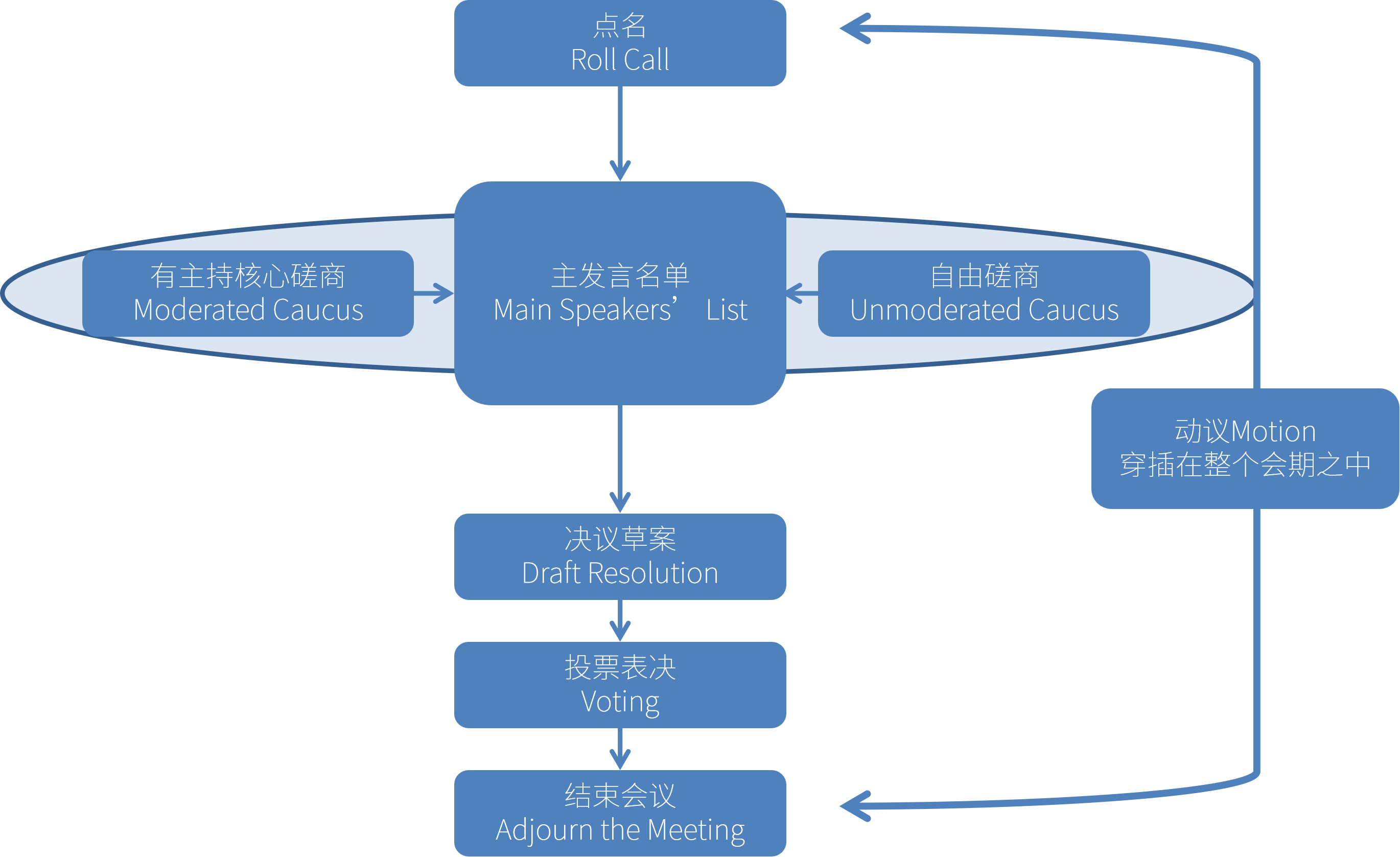
1. 点名
1.1. 在每次会议开始之前,主席团会根据国家顺序进行点名;被点到国家名的代表应当举起国家牌并答“出席”。
1.2. 迟到的代表应当向主席团递交意向条,说明自己已经到场。
1.3. 每个委员会至少须有二分之一的成员国出席,主席才可宣布开会。
2. 主发言名单
2.1. 点名之后,主发言名单无需动议开启,所有国家名单会公布在屏幕上。
2.2. 被列入主发言名单的代表们将会有120秒的发言时间,代表们可以围绕会议议题进行演讲。
2.3. 未被主席列入主发言名单的代表,可以通过志愿者向主席团递交意向条的方式,表明自己希望被列入主发言名单。在得到主席团的同意后,其所代表的国家将会被列入主发言名单。
2.4. 如果代表发言结束后的剩余时间大于或等于15秒,代表可以选择让渡:
若让渡给主席 主席自行处理剩余时间
若让渡给代表 被让渡的代表获得剩余的发言时间
若让渡给问题 主席请希望提问的代表高举国家牌,主席随机点出一位,该代表进行提问(提问不占用时间),发言代表使用剩余的时间对问题进行回答。
若让渡给评论 主席请希望评论的代表高举国家牌,主席随机点出一位,该代表获得剩余的时间对刚才的发言进行评论。
*注意,任何形式的让渡都不能再次让渡
2.5. 主发言名单可以被动议、决议草案讨论、修正案等中断。
2.6. 当主发言名单上的所有国家发言完毕,此时代表们应当动议进行决议草案的投票。
3. 有主持核心磋商和自由磋商
3.1. 在会议期间,代表可随时提出程序性动议。此类动议包括:动议开启发言名单、动议进行有主持核心磋商或自由磋商、动议暂停会议或动议休会等。
3.2. 动议有主持核心磋商的代表需要阐明磋商的主题、总发言时长(一般建议10分钟)、每位代表的发言时间(一般建议60-120秒)。
3.3. 动议自由磋商只需要代表提出总时长即可,通常不超过20分钟。
3.4. 主席有权建议代表对动议内容做出修改。
3.5. 当有主持核心磋商的动议通过,主席将选择一定数量的代表进行发言。提出该动议的代表可选择首位发言或末位发言。
3.6. 在有主持核心磋商开始之后,除中止进行中的有主持核心磋商外,代表们不能够提出其他动议。
3.7. 在每次会议接近尾声的时候,主席有权建议代表们动议暂停会议。
4. 问题
4.1. 代表们可以提出程序性问题、咨询性问题和个人特权问题。
4.2. 问题不需要投票但需要主席的同意方可生效。
4.3. 代表可以通过举牌示意并说出“问题”或传递意向条两种方式向主席团提出问题。
4.4. 当代表对议事规则和内容存在疑问时,可提出咨询性问题(Point of Inquiry)向主席团寻求解释;当代表对程序执行有疑惑时,可提出程序性问题(Point of Order);若代表因个人不适影响参会,可提出个人特权问题(Point of Personal Privilege)请求休息或调整。
5. 决议草案
5.1. 起草国是一份决议草案的主要提交国,附议国是对决议草案进行附议、认为其有讨论价值的国家。一份决议草案的起草国和附议国的总数应达到出席代表的20%,即,决议草案提交门槛数。
5.2. 一份决议草案的起草国不能够成为其他决议草案的起草国或附议国。
5.3. 决议草案需要包括序言性条款和行动性条款两大部分:序言性条款用于介绍问题的背景、过往行动,而行动性条款则是用于阐述可行性的解决方法与措施。
5.4. 主席团会说明提交决议草案的起始和截止时间,以及有权将不符合要求的决议草案发回并要求起草国进行相应修改。
5.5. 决议草案将会按照提交的顺序进行排序。以“决议草案1.2”为例,“1”代表议题的顺序,“2”代表提交的顺序。只有经由主席团排序、受到主席团认可的决议草案才可以向全场代表分发。
5.6. 代表们在拿到决议草案后有5分钟的阅读时间。然后主席团会邀请三位相关决议草案的起草国代表进行通常为5分钟的介绍。
5.7. 决议草案介绍完毕后将进入问答环节。在问答环节中,任何代表可向宣读决议草案的三位起草国代表提出问题,并由三位起草国代表回答。
5.8. 如果有多份决议草案,代表们可以动议更改决议草案的投票顺序。该动议要求三分之二多数的代表支持才能通过,且只能被表决一次。
5.9. 决议草案需要三分之二多数的代表投票通过,才会生效成为决议案。该决议案代表了整个委员会的立场和行动,是这个委员会的成果的总结。
6. 投票
6.1. “出席代表数*1/2+1”构成简单多数。对于程序性问题的投票,如动议磋商、动议暂停会议,均需要简单多数的代表投票支持。在此类投票中,代表能且仅能投“支持”或“反对”。
6.2. “出席代表数*2/3+1”构成三分之二多数。对于实质性问题的投票,如动议对决议草案进行投票、非友好修正案逐条表决的投票,均需要三分之二多数的代表投票支持。
6.3. “出席代表数*2/3+1”构成三分之二多数。对于实质性问题的投票,如动议对决议草案进行投票、非友好修正案逐条表决的投票,均需要三分之二多数的代表投票支持。
6.4. 在会场内对决议草案的投票进行唱名投票,代表们可以投“支持”、“反对”、“弃权”或“过”。
6.5. 投“过”的代表需要在第二轮投票中再次投票,且只能投“支持”或“反对”。投“弃权”的代表将不被计入计算绝对多数的总数。
6.6. 在对决议草案进行唱名表决生成决议案后,主席团可以建议代表动议休会。
English-Speaking Committees
1. Roll Call
1.1. At the beginning of each session, the Dais will make a Roll Call, calling the names of member states and observers in alphabetical order. Delegates should raise their placards and say “Present” when their countries’ names are called.
1.2. Delegates who are late for the Roll Call are supposed to send pages to the Dais to state their presence.
1.3. The quorum requires the attendance of no fewer than 1/2 of the member states. Only when the quorum is fulfilled can the Dais announce the beginning of the session.
2. Main Speakers’ List
2.1. After the roll call, the main speakers' list is opened without needing a motion, and the list of all countries will be displayed on the screen.
2.2. Once being added to the Main Speakers’ List, delegates are given 120 seconds to speak, and they are allowed to speak generally on the topic.
2.3. Delegates who are not included in the Main Speakers’ List can be added by sending pages to the Dais with the help of volunteers, indicating their wish to be included in the Main Speakers’ List. Once obtaining the consent of the Dais, the country they represent will be included in the Main Speakers’ List.
2.4. A delegate may yield the remaining time, provided that at least 15 seconds left upon the conclusion of speech.:
Yield to the Chair — The remaining time is at the discretion of the Chair.
Yield to Another Delegate — The yielded delegate shall receive the remaining time.
Yield for Questions — The Chair shall invite delegates wishing to pose a question to raise their placards and will randomly recognize one delegate to ask a question (without time deduction). The original speaker then uses the remaining time to respond.
Yield for Comments — The Chair shall invite delegates wishing to comment to raise their placards and will randomly recognize one delegate, who shall receive the remaining time to comment on the speech just delivered.
Note: Any form of yielding cannot be further yielded.
2.5. The Main Speakers’ List can be interrupted by procedural motions, the discussions of Draft Resolutions, and Amendments etc.
2.6. Once the Main Speakers' List is exhausted, a motion from delegates to vote on the Draft Resolutions is required.
3. Moderated Caucus and Unmoderated Caucus
3.1. Procedural motions are in order at any time when the floor is open. Delegates can motion for open the Speakers' List, motion for a Moderated Caucus or an Unmoderated Caucus, motion to suspend the meeting, or motion to adjourn the meeting etc.
3.2. Delegates who motion for a Moderated Caucus must briefly explain its topic, specify time limit for the whole caucus (suggest 10 minutes) and the time span for an individual speech (suggest 60-120 seconds).
3.3. Delegates who motion for an Unmoderated Caucus only specify time limit for the whole caucus (not to exceed 20 minutes).
3.4. The Dais has the right to suggest changes of the caucus motioned.
3.5. If a motion for a Moderated Caucus passes, the Dais will choose delegates of a certain amount to speak. The delegate who presents the past motion has the alternative to choose speaking as the first speaker or the last one.
3.6. No other motions will be in order during a Moderated Caucus except a motion to suspend the ongoing Moderated Caucus.
3.7. At the end of each session of the conference, the Dais has the right to suggest a motion to suspend the meeting.
4. Points
4.1. Delegates are allowed to raise Point of Order, Point of Inquiry or Point of Personal Privilege.
4.2. Points do not require votes but only come into effect with the approval of the Dais.
4.3. Points can be raised either by sending pages to the Dais or by raising placards with saying “Point”.
4.4. Delegates have the right to raise Point of Inquiry to ask the Dais about the rules and content when they are confused. Delegates may raise Point of Order when they are confused about the procedures. Whenever delegates experience personal discomfort which affects their participation in the proceedings, they may raise Point of Personal Privilege to request a rest.
5. Draft Resolution
5.1. Sponsors are the primary proposing nation(s) of a draft resolution, while Signatories are nations endorsing the draft for consideration, affirming its substantive value. The number of Sponsors and Signatories shall add up to more than 20% of the number of delegates present.
5.2. Sponsors of a draft resolution cannot serve as Sponsors or Signatories for any other draft resolution.
5.3. A Draft Resolution should be divided into two parts that are Preambulatory Clauses and Operative Clauses. Preambulatory Clauses function as statements of the background, past actions taken and position. Operative Clauses are executable solutions and elaborate on feasible measures.
5.4. The Dais of the committee will announce that the floor is open for receiving Draft Resolutions and the corresponding deadline. The Dais is in authority to send back the Draft Resolution that fails to meet the criteria and requires corrections.
5.5. Draft Resolutions will be numbered according to the order. Take “Draft Resolution 1.2” as an example, “1” represents the order of topic discussed, and “2” represents the order of submission of Draft Resolution. Only Draft Resolutions approved by the Dais can be distributed among delegates.
5.6. After distributing the Draft Resolutions, the Dais will allocate five minutes for delegates to review them. Subsequently, the Dais will announce a five-minute introduction session, during which no more than three Sponsors may present the draft.
5.7. After the introduction, the Dais will automatically proceed to a five-minutes Q&A, during which each delegate is encouraged to ask or answer questions about any debatable standpoint of the Draft Resolution to the three Sponsors, and the three representatives should answer.
5.8. Motions to reorder Draft Resolutions are in order only before the voting of Draft Resolutions. This motion requires two-thirds majority to pass. And the same Draft Resolution can be voted only once.
5.9. A Draft Resolution shall come into effect as a Resolution only if it is passed by a two-thirds majority vote of the delegates. The Resolution represents the standpoint and actions of the entire committee and is a summary of the committee’s achievements.
6. Voting
6.1. Simple majority is calculated by rounded half of countries present and plus 1 (50%+1). It applies to procedural votes, including motion for caucus, motion for suspend the meeting. In such votes, delegates may vote only “Yes” (For) or “No” (Against).
6.2. Two-thirds majority is calculated by rounded two-thirds of countries present plus 1 (2/3+1). It applies to substantive votes, including voting on a Draft Resolution, clause-by-clause voting on an Unfriendly Amendment.
6.3. “Number of delegates present × 1/5 + 1” constitutes the threshold for submitting a draft resolution. A draft resolution can be submitted to the Dais only when the total number of its sponsors and signatories reaches or exceeds this number.
6.4. A Roll Call voting is required when voting on a Draft Resolutions. Delegates shall vote “Yes”, “No”, “Abstain” or “Pass”.
6.5. Delegates who have voted “Pass” shall only vote “Yes” or “No” in the second round. Those who voted “Abstain” will not be counted in the total number of absolute majority.
6.6. When the Roll Call voting on the Draft Resolutions has been completed, the Dais has the right to suggest a motion to adjourn the meeting.